
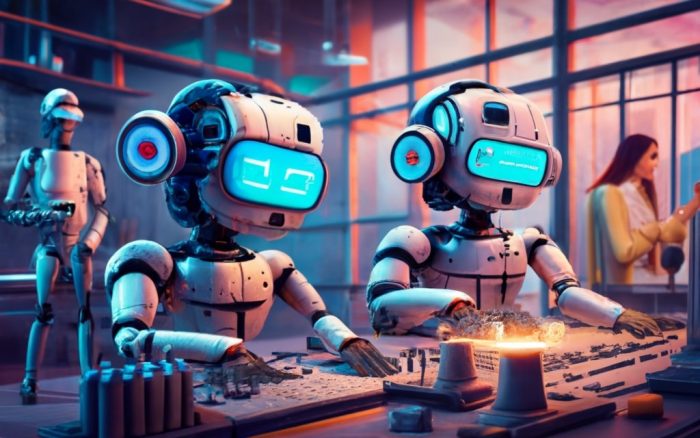
Boring jobs for robots, interesting jobs for humans?
As robots and AI take over routine and repetitive work, they will free up humans to focus on more complex tasks that play to our strengths.
This could lead to the creation of new jobs that require higher-level skills like critical thinking, problem-solving, and social intelligence. While robots may handle the dull duties, humans will have more opportunities for meaningful and engaging work.
However, According to the World Economic Forum’s “The Future of Jobs Report 2020,” AI is expected to replace 85 million Jobs worldwide by 2025!
AI has already been responsible for job cuts in various sectors, with nearly 4,000 job cuts in May 2023.
The impact of AI and automation on jobs and the economy is a topic of significant concern. The arguments for and against this impact are as follows:
Supporting arguments for the impact of AI and automation on jobs and the economy are:–
• Repetitive tasks can be performed more efficiently and accurately by AI and automation, leading to increased productivity and output.
• When human workers are replaced with AI and automation, businesses can reduce labor costs, potentially leading to lower prices for consumers.
• Hazardous or dangerous work environments can be handled by AI and other robots, reducing the risk of injuries or accidents for human workers.
• AI and automation can free up human workers to focus on more creative and complex tasks, leading to increased innovation and the development of new products and services.
• The implementation of AI can lead to the redundancy of some jobs but also create new roles and opportunities, especially in fields related to AI development and maintenance.
• The widespread adoption of AI and automation contributes to economic growth by streamlining processes, increasing efficiency, and driving technological advancements.
Argumentative statements for the impact of AI and automation on jobs and the economy are:–
• Job losses and unemployment for workers result from the automation of certain tasks that are easily replaceable by AI and automation.
• The implementation of AI and automation requires workers to possess more advanced technical skills, creating a gap between the skills demanded by new jobs and those possessed by displaced workers.
• The benefits of AI and automation primarily accrue to those who own or control the technology, potentially leading to an increase in income inequality and the concentration of wealth.
• The introduction of AI and automation faces resistance from individuals who fear job loss or feel threatened by the technology, potentially slowing down its adoption and implementation.
• The use of AI and automation raises ethical dilemmas, including issues related to privacy, algorithmic bias, and the potential misuse of artificial intelligence for surveillance or control purposes.
• Widespread adoption of AI and automation may disrupt entire economic sectors or industries, leading to struggling businesses, reduced employment opportunities, and potential economic instability in the short term.
Humans still needed to manage and oversee AI.
Even as AI systems get smarter, they will still require human oversight and management. Someone will need to train the algorithms, monitor their performance, identify errors, and make ethical decisions.
This means jobs like AI ethics specialist, data quality analyst, and AI system designer are likely to emerge and grow. Humans will be needed to keep AI systems in check and steer their development in beneficial directions.
Humans and AI will likely work side by side.
Instead of replacing humans, AI is more likely to augment human capabilities. We’ll see more partnerships where AI assists and enhances human work.
This could mean AI providing real-time decision support, monitoring systems for errors, or automating routine subtasks. By working together, humans and AI may be able to accomplish things neither could do alone.
Robots can’t fully replace human creativity. Robots may be able to perform routine tasks more efficiently, but they will struggle to come up with truly novel ideas or make unexpected connections. When it comes to innovation and inspiration, humans have the edge for now.
Even though there has been widespread talk that someday we will become slaves to AI, if we look back at our history, humans have been enslaved by other humans, time, overwhelming responsibilities, tyrants, and dictators.
However, somehow machines have turned out to be our innovative allies or innovations that we see as part of our legacy or support systems. They have also become big brands that motivate us to work and make them our dream target companies. If we look in depth, they have created more jobs than we could ever imagine.
Sources:- builtin, indiatoday, Techtarget, Harvard Business Review
 ledlights