
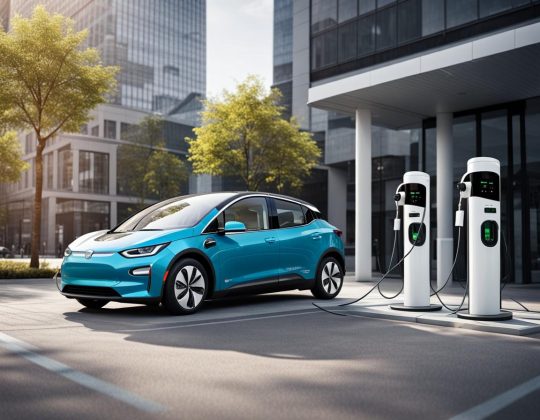
The system is with an EV powertrain providing power to the wheels of an electric vehicle (EV). Unlike conventional vehicles that use an internal combustion engine ICE, an EV powertrain uses an electric motor and a battery pack as the main sources of power.
An EV powertrain also consists of other components such as an inverter, a DC/DC converter, a charger, and a battery management system (BMS), helping to control and manage the power flow and performance of the EV.

“Driving an electric vehicle is like having a silent disco on wheels – smooth, electrifying, and leaving the planet with a lighter carbon footprint.”
An EV powertrain got several advantages over an ICE powertrain, such as higher efficiency, lower emissions, lower noise, and simpler design. However, an EV powertrain also faces some challenges, such as limited range, high battery cost, long charging time, and lack of charging infrastructure.
There are different types of EV powertrains, such as hybrid electric vehicles (HEVs), plug-in hybrid electric vehicles (PHEVs), battery electric vehicles (BEVs), and fuel cell electric vehicles (FCEVs) with different configurations and characteristics.
Top benefits and hurdles of EV powertrains:-
HEV
HEVs use both an electric motor and a gasoline engine to improve fuel efficiency and reduce emissions. However, they are heavier, more complex, and still dependent on fossil fuels.
PHEV
PHEVs have larger batteries than HEVs and can drive on electric power alone for a limited range before switching to the gasoline engine.
Envrionment: Emission reduction because of battery and e-motor, but ICE still primary source of propulsion.
Benefits: Use of existing fuel infrastructure. Similar range as ICE.
Hurdles: Low range on just e-motor. ICE is still the primary source of propulsion- substantial emissions on longer trips.
REEV
Environment: Substantial emission reduction compared to ICE- emission only when range extender is used.
Benefits: Extender provides higher range than BEV. Real electric car, less range anxiety.
Hurdles: Additional complexity and cost compared to a BEV. Extender offers limited additional range.
BEV
BEVs run entirely on electric power and have no tailpipe emissions. They are simpler, quieter, and cheaper to operate than HEVs and PHEVs.
Environment: Zero emission cars, far more efficient well-to-wheel than ICE.
Benefits: Pure electric, zero emission car. Charging possible at home/office etc; infrastructure growing.
Hurdles: Refuelling takes long, even with fast charge at least 20-30 minutes. Relatively low current range. Infrastructure required, availability limited but growing.
FCEV
FCEVs use hydrogen fuel cells to generate electricity and emit only water vapor. They have longer range and faster refueling than BEVs, and they can use renewable hydrogen sources.
Environment: Zero emission cars, far more efficient well-to-wheel than ICE.
Benefits: Range is high. Refueling takes only a few minutes.
Hurdles: Energy-intensive to produce hydrogen. Hydrogen infrastructure required- currently very limited.
Sources:- ieeexplore, make us of , Duke Today, EVreporter, autotechdrive, powerelectronicsnews, mckinsey
 ledlights