
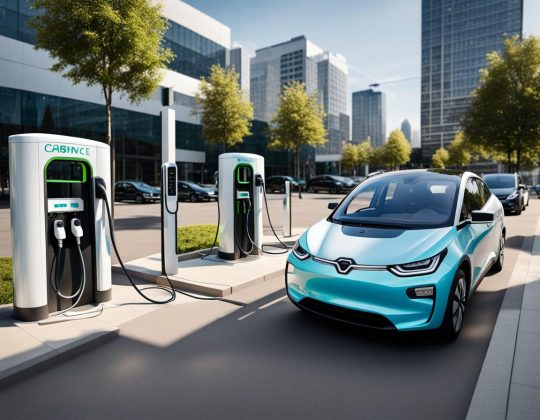
Hmm.. the scenario is quite complex to think that there is a rivalry going on to capture the growth in the Japanese market and how competitive and challenging it can be for foreign brands. Who got more potential in the Japanese market?
Japan’s economic outlook is positive, as it has recovered from the pandemic and achieved above-potential growth. However, domestic demand remains sluggish, and inflation is high, limiting the purchasing power of Japanese consumers.
Japan also has strong trade ties with both America and Europe, but the balance of trade varies by sector. For example, Japan also imports more goods from America than Europe but exports more services to Europe than America. The bilateral trade agreement also supports decreasing tariffs and other barriers to US auto exports to Japan.
Let’s dive into the current and potential foreign EV brands expanding in the Japanese EV market:
- Mercedes-Benz: The German luxury car brand was Japan’s best-selling foreign car brand in 2021, with a market share of 16%. Offered a range of models, from sedans and SUVs to sports cars and electric vehicles, appealing to the high-end segment of the Japanese market.
- BMW: The second-best-selling foreign car brand in 2021, with a market share of 10.2%. BMW also offers a variety of models, including hybrids and electric vehicles, catering to the premium segment.
- Jeep: The only American car brand in the top ten, Jeep was Japan’s eleventh-best-selling foreign car brand in 2021, with a market share of 3.4%. Jeep is famous for its rugged and adventurous models, such as the Wrangler and the Grand Cherokee, attracting a niche segment of the Japanese market.
- Tesla: The only non-Japanese brand in the top ten EV brands in terms of sales and market share. In 2020, Tesla sold around 2,000 Model 3 vehicles in Japan, accounting for approximately 0.7% of the overall EV market.
- Volkswagen: The world’s largest manufacturer and one of Europe’s top EV companies, is the most ambitious foreign EV brand in Japan. Volkswagen has unveiled a plan to become the global leader in EVs by 2025, with Japan as a major market. Volkswagen plans to introduce ten new EV models in Japan by 2025, including its flagship ID series, which will be based on the company’s specialized EV platform known as MEB.
Let’s analyze the strengths and weaknesses depending on various factors:
- America had a larger share of the Japanese automotive market than Europe, accounting for 10% of the total passenger car sales in 2022 compared to about 6% for Europe. However, Europe had a higher growth rate than America, increasing its sales by about 15% in 2022, compared to about 8% for America.
- America has a competitive advantage in the electric vehicle (EV) segment, which is proliferating in Japan due to the government’s incentives and regulations. Companies like Tesla, Ford, and General Motors made substantial investments in electric vehicle (EV) technology and bolstered their influence and market presence in Japan.
- Europe, on the other hand, is lagging in the EV segment, facing challenges from the lack of infrastructure, standardization, and consumer demand.
- Europe did get a competitive advantage in the luxury car segment, a growing segment in Japan due to the rising income and wealth of Japanese consumers.
- On the other hand, America struggled in the luxury car segment, facing difficulties from the high cost, low reliability, and low image of their products and services.
As we can see, the growth in the Japanese automotive market in America and Europe also depends on the specific segment, product, or service offering the ability to adapt to the Japanese market conditions and consumer needs.
It is strange that even though Europeans are considered iconic leaders in the automotive industry, brands like BMW, Audi, and Porsche have created a craze beyond your imagination but have failed to compete with American automakers and are outperformed in Japan.
Let’s try to analyze why the European companies were struggling to compete in the Japanese EV market.
- Japanese customers’ strong affinity for native brands and models. Consumers prefer to purchase EVs from local automakers with a long history and reputation in the Japanese market, such as Toyota, Nissan, Honda, and Mitsubishi.
- The preferences are also more for purchasing electric vehicles that comply with Japanese norms and laws, such as the CHAdeMO charging protocol.
- There is a lack of incentives and policies in Japan for boosting international EV brands and models. The subsidies, tax breaks, and preferred parking and toll payments available in Japan for electric car purchasers and owners are limited and vary by location and vehicle type.
- The lack of infrastructure and network in Japan supports international EV brands and models. Private charging outlets in homes and workplaces are widely available in Japan, although they are not compatible with or accessible to international EV brands and models.
- Japan also has a larger network of public charging stations and service facilities, dominated or controlled by domestic EV manufacturers and models. Foreign EV brands struggle to use suitable charging stations or maintenance services in Japan.
- According to prominent sources, European automakers in Japan have a lower market share and sales volume than Japanese and American automakers. In 2020, European automobile firms accounted only for 6.6% of total passenger car sales in Japan, while Japanese car companies accounted for 88.9% and American car companies accounted for 4.5%.
Also, due to bilateral collaboration between Japan and the USA,
As per USTR reports, “with the participation of Japan, TPP countries accounted for nearly 40% of global GDP and about one-third of all world trade. Japan is currently the fourth-largest trading partner of the United States. The United States exported $67 billion in goods and an estimated $47 billion in services to Japan in 2014.”
The movement also supported American offerings with more models and alternatives that appeal to Japanese consumers, particularly in the electric and hybrid sectors. Another probable reason for American car firms performing better in Japan is the greater incentives and assistance from the US government and industry to join and expand in the Japanese market.
Sources:- curbsideclassic, Tokyoesque, focus2move, jama, MHH Japanese cars, iea, deloitte insights, Japan econmic outlook, economist, statista, Car selling statistics
 ledlights