
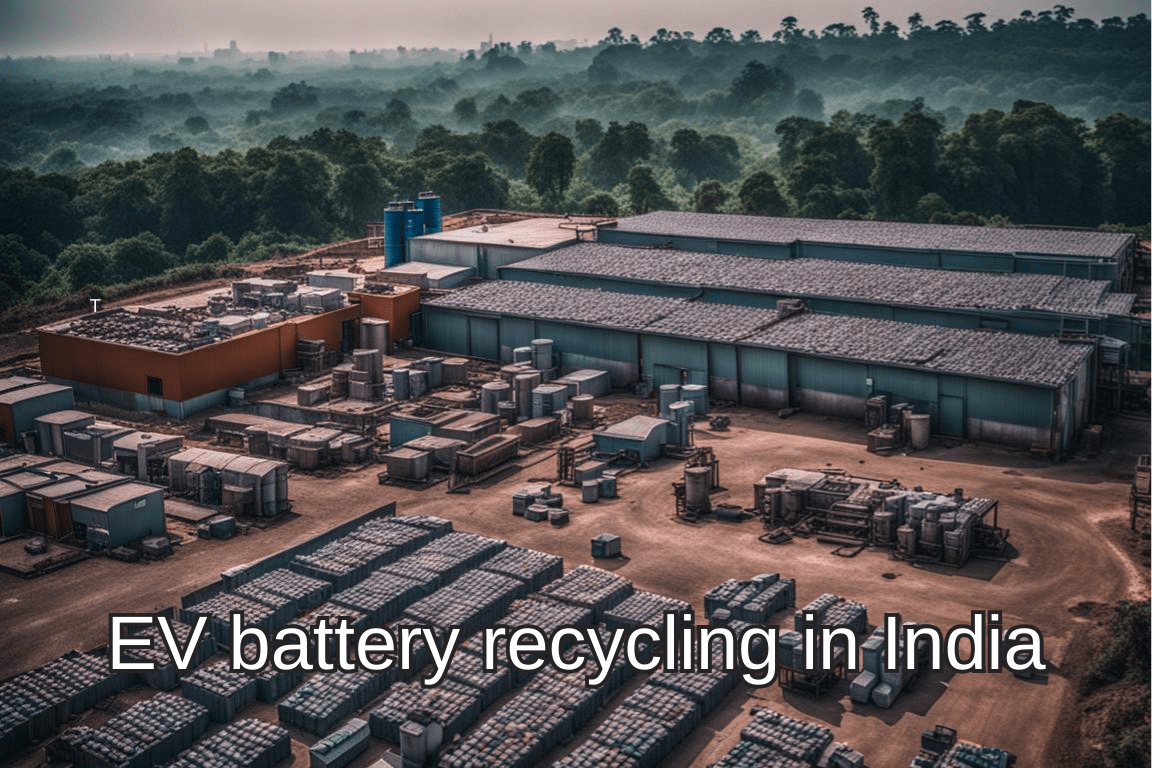
EV battery recycling in India
In India, the collection rate for batteries is a critical aspect of the evolution of the battery recycling ecosystem.
Battery recycling ecosystem
According to Transportweek, the rise in the global demand for batteries is driven by electric vehicles (EVs). The market in 2021, reached 330 GWh, and by 2022 it increased to 550 GWh.

The growth in the battery demand intensified the critical materials needed in battery production.
Critical materials for EV Batteries
An increase of 180% in lithium production since 2017, where the demand still exceeds the supply of upstream battery raw materials with a rising price experience. China also dominates the battery cell with cathode manufacturing.
Battery recycling market in India
As per the Ministry of Environment Forest, and Climate Change (MoEFCC), battery waste management rules in 2022 applied for all battery types irrespective of shape, volume, weight, material composition, and its use.

The roles and responsibilities covered producers, consumers, waste management authorities, recyclers, and pollution control boards.
As per WRI INDIA,
“According to National Institution for Transforming India (NITI) Aayog estimates, that new batteries will create a recycling volume of 128 GWh by 2030, of which around 46 percent will come from EVs. To treat this volume, India’s lithium battery recycling capacity would have to increase about 60 times over the next eight years, from the current level of 2 GWh (Times of India 2023).”
Battery recycling companies in India
By October 2022, Attero present recycling of 3,500 MT of Li-ion waste in India and also expanding the capacity to 11,000 MT.
The technology & Infrastructure were created by LOHUM to recycle 2 GWh and reuse 300 MWh of battery capacity per annum.
1 billion lithium-ion cells will be recycled by BatX Energies over the next three years in 2022. Annually up to 15,000 metric tons of black mass were produced by BATX with a mixture of battery anode and cathode material. Also, 30,000 metric tones of battery input were involved.
Sources:- Statista, transportweek, etn, thebatteryshow, evreporter
 ledlights