

Exclusive interview with Pranay Luniya, Co-founder & CEO, Quintrans Hyperloop. Vegapod Hyperloop was founded by Pranay as one of the India’s leading Hyperloop Research Unit.
Q: Tell me about yourself and your journey to Quintrans. What inspired you to Co-found Quintrans Hyperloop? What are your long-term visions for the company?
Pranay Luniya:
We started as a research unit at MIT-Pune. We were sophomore students interested in and fascinated by how the Hyperloop technology works. That’s how we started as a research unit, and for 3 years we worked on it as an engineering project.
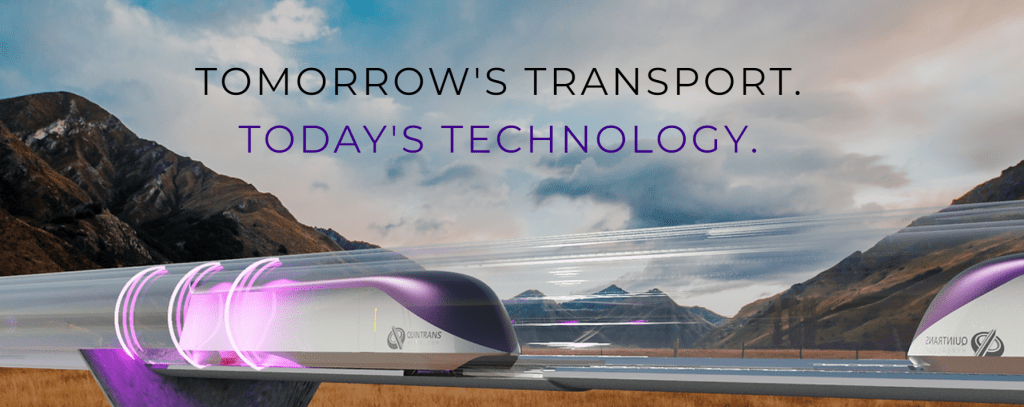
Soon after that, we realized the potential it holds and how we can commercialize the technology, and that’s how Quintrans started. At Quintrans, our vision is to develop a sustainable mode of transport that is clean, can generate energy on its own, and is a mass mode of public transport.
Q: How Indian transportation can be revolutionized in India through hyperloop technology?
Pranay Luniya:
India has been facing rapid urbanization, especially in Tier 1 cities. This has caused traffic congestion and pollution, and the standard of living has decreased.
This massive urbanization is due to people flocking from Tier 3 or 4 cities for more opportunities. However, with Hyperloop, the entire transportation system can be revolutionized, so people can still stay in one city and travel to another for work.
Q: What unique features make Quintrans’ hyperloop design reliable and efficient?
Pranay Luniya:
Our USP lies in making extremely efficient patented linear motors and a cost-effective concrete-based tube. With these, the implementation of Hyperloop becomes quicker and easier. Our hybrid levitation technology also helps reduce energy consumption, making it more efficient and fail-safe.
Q: Could you elaborate on the safety aspects of hyperloop technology? How Quintrans are addressing the safety issues and challenges?
Pranay Luniya:
Safety is a major aspect of passenger hyperloop. While it’s been talked about, there is still a lot to be worked on. We have aimed to address all the safety issues from the point of view of our systems. These systems are then put to the test to make sure we are meeting our goals. We have also partnered with ARAI to get their expertise in passenger safety for Hyperloop.
Q: What strategies is Quintrans implementing to make hyperloop infrastructure cost-effective?
Pranay Luniya:
As mentioned, our novel composite concrete tube helps to reduce the tube costs by a massive 40%, while both our linear motor and hybrid levitation technologies help to reduce the operational costs of Hyperloop. In the long term, this will help us make the Hyperloop cost-effective and affordable for everyone.
Q: How does the projected cost per kilometer compare to other transportation projects such as the Mumbai-Ahmedabad bullet train?
Pranay Luniya:
The Mumbai-Ahmedabad Bullet train has cost 220 crores per kilometer; comparing it to Quintrans, we are projecting it to be 150 crores per kilometer, making it one of the most cost-effective hyperloop designs in the world.
Plus, there are other socioeconomic benefits like zero carbon emissions, low right of way and land requirements, energy generation, etc. compared to bullet trains and maglevs.
Q: How Quintrans are addressing the carbon emissions and energy consumption concerns?
Pranay Luniya:
Hyperloop is a net-zero direct carbon emission mode of transport, and with the solar panels lined across the tube, we can also generate energy to give it back to Hyperloop, which helps to also run Hyperloop on clean energy.
We have partnered with a Circular Economy company to also help us track down the energy consumption and usage of waste in our technology to further make it more sustainable.
Q: As an Asian hyperloop pioneer, how do you see the market potential for hyperloop technology in India and beyond? What massive opportunity India can gain with this connectivity?
Pranay Luniya:
India has a number of cities set 100–500 kilometers apart; just like railways, India can potentially have the biggest hyperloop network in the world. India has also lacked any kind of high-speed rail network for years, so this leapfrogging in terms of technology makes sense to achieve Hyperloop in India.
Q: Why strategic partnerships are important for the future of hyperloop transportation? Are you looking towards any of such partnerships?
Pranay Luniya:
Hyperloop requires governments, investors, technology partners, and others to come to a strategic agreement to implement the technology. We have been working with the state governments, ministries, and other local bodies, but also with major infrastructure players and other technology partners.
Thank you for your time.
Stay tune for more such cool interviews.
 ledlights