
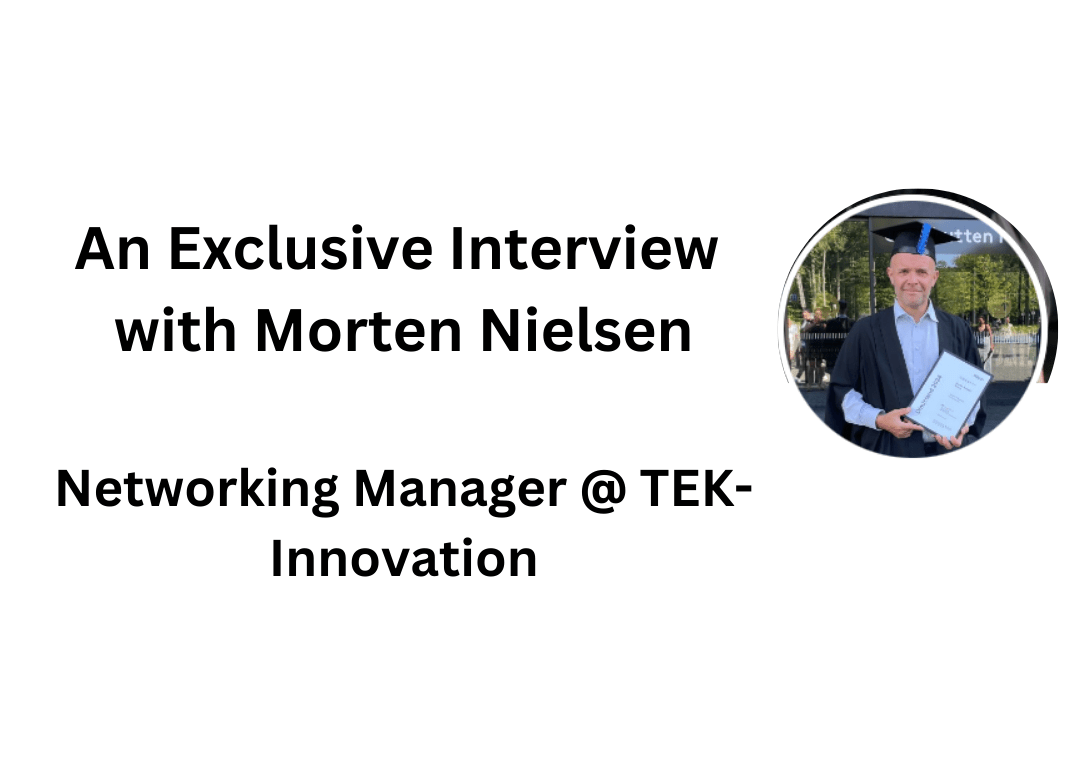
An exclusive interview with Morten Nielsen, Networking Manager @ TEK-Innovation. He is known for his “profound ability for strategic planning, based on a high sense of empathy and understanding of human interaction“.
Q: Tell me about yourself? What sparked your interest in SDU?
Morten Nielsen:
Well, I became a robotics engineer about some 20 years ago, and I was just for a while with railroads, but then I came back to robotics here in Odense.
I was working with DTI, the Danish Technological Institute, which is the largest RTO in Denmark, and they have a lot of… They have a lot of activities in applied robotics research.
In terms of applied robotics research, they are the bridge between the university and industry. So I worked with them for some six years and I was spearheading DIRA, the Danish Industrial Robot Association.
You can go online and you can write ROBOTBRAG (Danish Robot and Automation Expo), which actually just means “bang” in Danish, but it means something else. But that is their yearly report.
An annual event at DTI where you can go and check out some of the things that DIRA does. I worked a lot with industry and I showed talent within networking and project management and events, development and execution to the extent that I on behalf of SDU was organizing the ERF, the European Robotics Forum, the largest robotics conference in Europe.

Europe. I was organizing that on behalf of SDU last year here in Unzen. You can actually find the website on erf2023.eu. So there’s a lot of information in there and you can find out what is this conference all about.
So I was actually headhunted to SDU because I originally came here for a position in what was then called RoboCluster, which was a robotics cluster that was here at SDU.
And the cluster manager had quit his job. He wanted to do something new. And I was available. So the institute director for the Maersk McKinney-Müller Institute, which is the robotics institute here. And yes, it is sponsored by Maersk, the big shipping company.
There’s an entire story behind that, how robots were made for the shipping industry back in the day. But he called me, and his name is Kasper Hellenboe. And the funny thing is that he and I were actually student buddies. So he called me and said, Morsen, would you come by for a chat?
And then about six years ago, I started as cluster manager. Then RoboCluster was discontinued and actually assimilated by the now national cluster audience of robotics.
And I stayed at SDU in what is called tech innovation, which is like a support function within the faculty where we support the researchers with the application writing. which is not my job, also project management for the larger academic projects.
That’s also not me. But then we had the innovation team where we just come up with crazy ideas and then make them happen. So that’s sort of my job is to make the impossible a success, basically.
Q: Can you shed light on the importance of SDU? How it is important in 2024? What are its goals?
Morten Nielsen:
Oh, in that case, I mean, I think this is a question for the researchers, but I could mention that we have what is called the LSP project, Large Structure Production. You can also look that up.
And this is on the Ulster Harbor, and it’s a project where we will construct, at least in European terms, maybe even worldwide, the largest gantry robot with four robot arms on it to do entire ship segments to do entire construction, maybe even entire houses will be built 100% automatically by robots.
So I would say this is at least one area that we are focusing a lot on this year. We even have a new center named after that. Then, of course, we have SG Robotics which works in developing robotics for industry.
As I mentioned before, we are very closely tied with Universal Robots, which is the one company that is a spin-off of SDU and the largest cobots company in the world now, and definitely also the largest company in our robotics cluster here.
So that being said, that’s some of our focus, and we are focusing more and more on drones. We have an airport close by, and that airport has some… very good opportunities in terms of flying drones also beyond the visual line of sight so we can do testing out there and work and do research in drone technology.
So these are some of the areas.
Q: Could you describe your journey in the robotic industry?
Morten Nielsen:
Yeah, well, I sort of already did that. As I said, I became a robotics engineer about 20 years ago. And just before the financial crisis, I got a job with the railroads, worked for the Danish railroads for a few years. I have been working in risk management and fire prevention, actually, also.
But then I came back to robotics. I applied for a job with DTI. And I was there becoming a consultant. And then I was heading the Danish Industrial Robot Association (DIRA) for a few years.
And then I was looking for new challenges and was for a short while export director for a machine building company before I came to RoboCluster, which was part of SDU. And then I chose to stay at SDU.
I’ve been here for six years now.
Q: Is it true that robots are replacing humans?
Morten Nielsen:
No, this is, I mean, the dialogue about robots replacing humans was closed, at least in, I would say, even across the European continents quite a few years ago, because there is a, and that actually ties into the biggest fear, the biggest challenge.
The biggest challenge right now is skilled laborers. From skilled labor, all the way from PhDs, R&D engineers, and to people in operations on the factory floor. I mean, we absolutely need robots to do as much automation in our factories as humanly possible, because for several reasons.
I mean, wages in Denmark are relatively high, which means that if we want to compete, we need to automate. That’s one thing. But also the jobs, I mean, the jobs are there, but there’s nobody to take them.
So we are trying to automate as much as possible. So I would actually argue that robots create jobs. And the way robots create jobs, at least in Denmark, is that, well,
if you have a company and they automate, then they become, hopefully, they become internationally, globally competitive, which means that they can keep and expand their production in Denmark.
And yes, there may be some factory workers on the factory floor that loses their job on the short term. But if you then are competitive and you start selling more products, however, made by robots, you’re going to have a bigger sales force. You’re going to have more after sales service.
Your R&D department and your administrative departments are going to be larger. So at the end of the day, it does take some jobs from one part of the company, but then it actually creates more jobs somewhere else in the company.
Q: How much cost saving is possible with the use of robots?
Morten Nielsen:
Yeah, I can try. I mean, these are very rough estimates because I don’t know the exact numbers, but my guess is that a factory worker probably makes in Denmark somewhere around 40,000 to 50,000 euros a year.
We have high taxes here. Remember, it’s at least 50%. And a universal robot arm would probably set you back some 20,000 euros, I guess. And then you need to integrate it, and you need to have some grippers on it. So let’s just say that a robotic solution… is also about 40 to 50,000 euros.
So the payback or the return on investment would be within 12 months. And I also know from when I was more closer to industry than I am now, that this would also be the payback time that they will be looking at, you know, is our investment paid back within 12 months?
And if it is, then we will try to automate this. And that is both for the cheaper solutions, but you have also the multi-million, Euro solutions at the bigger companies, you know, where they automate entire production lines and they have a completely different requirement.
But at the end of the day, they’re asking themselves, how fast can we actually get our return on investment? I also know from concrete examples that some companies, Danfoss, for instance, which is a company that makes thermostats for radiators, they have 45,000 people worldwide.
It’s a privately owned company. They have actually pulled some tasks back that was originally outsourced to China. They have pulled them back to Denmark. I mean, they had, say, 200 people on a production line back in the 80s and 90s.
And then they outsourced it to China where they had 200 people on a production line. And then they made a robot solution or two or whatever in Denmark. and they could now have the same production line running with 10 people.
Because now the robots would be doing the work and you would have the caretakers of the robots or the operators.
So this from a Danish perspective is of course a positive story. India being to some extent a developing country is of course a little bit sad because what you will probably see and also for the Chinese part, is that the companies in Europe and in the U.S. are going to try to pull as much production home as possible.
And I think that COVID was something regarding supply chains.
All of a sudden, some commodities were unavailable because they were made in China, and China was all locked down.
And global shipping was also, to some extent, affected. So we learned that some of the spare parts that we need, we might actually want to look into producing them, maybe not in Denmark, but at least on the European continent so they can be brought here by truck or by car, right?
Q: But during COVID, roads were also close?
Morten Nielsen:
No.
There was a very short time where we could not leave the country. I think for about two or three months in the winter of 21, maybe it wasn’t 20, the German-Danish border was closed for private traffic only, not for commercial traffic.
But we have had some times where they suggested that you would not visit certain parts of the country, but we have not had lockdowns that was enforced.
For the rest of Europe, it was the same thing that we could travel relatively freely, but there were some guidelines.
Q: Top 5 facts to know about the robotic industry in Denmark?
Morten Nielsen:
The first, the Cobot was invented here. No. The Cobot was invented here, and for those of you who are subscribers who don’t know, a Cobot is a collaborative robot.
That means a robot that is able to work alongside and assist humans. And the collaborative robot was invented by Universal Robots, or by the founders of Universal Robots, which means that it was actually invented at this very institution.
Now there are Cobots everywhere, but back then it was a big thing.
Secondly, We are a 35-year-old ecosystem. It started out at the local shipyard where they wanted to develop robots for making ships because we were not competitive due to then it was the Korean shipyards.
Third, unfortunately, the shipyard closed and that could have been the end of the ecosystem. However, the municipality and the local government stepped in with some funding and And then that was around the early zeros. And then there has been a lot of effort to actually get this ecosystem up and running.
We have about 18,000 people working in this ecosystem in about 550 companies. It’s a triple helix system, where SDU and the other Danish universities are the academic part.
Fourth, then we have the entire industry, where Odense Robotics has a national cluster for drones and robots, are sort of the administrative representative. And then at least the municipality here in Odense, but also the government of Denmark is actually very supportive of robots.
And as I mentioned before, this is because I think only surpassed by Norway and Switzerland, I think the Danish wages are the highest in the world.
Fifth, So that means that if we want to produce in Denmark, we have to automate and everybody knows this. But robots are also finding their way into Europe. into healthcare they’re finding their way into to all sorts of things um so so and and we also working with drones so so it’s a it’s an ecosystem that is unfortunately fortunately renewing itself.
Q: What’s from the Danish Government’s area of interest?
Morten Nielsen:
The Danish government has appointed, I think, what they call 12 light towers, which are like areas of certain interest, where Medtech is, of course, one of them.
We have, I don’t know if you know this, but Novo Nordisk is a Danish pharmaceutical company, and it’s actually now the largest company in Europe.
I mean, it is so large that And if they took everything out of Denmark, we would actually be able to see it significantly on our gross national product. That is how large the company is, which, of course, also has its own set of challenges.
But, of course, it’s nice because they produce this dietary pill that I don’t remember the name of, and it’s become a huge success. But they do actually produce diabetes medicine, is what is their original goal. And we have, of course, as I mentioned before, Lego, which I guess all kids know Lego Blocks is a Danish company.
And they do have some production around the world, but they have their core production still here in Denmark. And if we want to keep these production sites in Denmark, I mean, there is no discussion.
It will be automated. I mean, Novo Nordisk is just building a new facility for production right outside of Odense here where I live. And my guess is that that is going to be,
I mean…
That’s going to be interesting because that’s a completely new factory, and I envision that that will be 95% automated. I mean, we will probably see a factory with almost no factory workers.
Q: What’s your opinion on robots snatching jobs from people? Do you get to see that in Denmark?
Morten Nielsen:
Is there? I think this is interesting, because we also had this discussion about robots stealing jobs, but that was extinguished more than 15 years ago.
There is no discussion about that in Denmark anymore. Even the unions for the factory workers say, We need robots and we need education for our members on how to use the robots.
Q:What about the self-driving vehicles in Denmark?
Morten Nielsen:
Well, there are some safety issues there and some legislative issues. But I mean, the reason why we don’t have self-driving cars all over Denmark is also a little bit due to technology, right?
But we do see autonomous vehicles in factories. We see them in hospitals. carrying stuff around. And they also now are used in shopping malls and stuff, you know, just to drive around with commercials on them, which is a bit,
if you ask me a little bit of an overkill, but I mean, there is literally no discussion in Denmark or I would say even across Europe, you will be hard-pressed to find somebody with reasonable knowledge in the area that will that will say that robots is a bad thing for our economy.
I mean, you can always find some flat-earther equivalent who is willing to talk bullshit about robots. But at the end of the day,
Q: What will you say to the Youth from India towards the robotics industry? What’s your suggestion to them for their career in the robotics world?
Morten Nielsen:
I would say to the youth of India, I mean, any education in STEM, be it in robots or any other sort of natural sciences or math, is probably going to get you far. And also, this is my personal note, is that I work as a networker. And I would say, you know, go out there, get to know people.
As I mentioned before, we have the International Summer School. Elite Summer School in Robotics and Entrepreneurship, where we invite 50 students every year.
Two of them are coming up from India, from IIT Kanpur. We already had two last year and two the year before. So we are, to some extent, also reaching out to India in order to try to do collaboration across the, between, in this case, SDU, but Denmark and Europe.
But I would say, Be open. Make sure to get to know people. And then, of course, study hard, you know, and have goals. And don’t be afraid to tell people what you want. All right. Thank you very much.
Thank you very much. Thanks a ton.
 ledlights