

Do you think that to overcome common IIoT adoption challenges are an easy path? Just go through the steps and done. I don’t think so, the first challenge is always to identify such hurdles and then mitigate or find the solution.
We are aware of the significance of the rising demand for IIoT devices and most importantly, the need for the devices for an advanced society to function in a smart ecosystem.
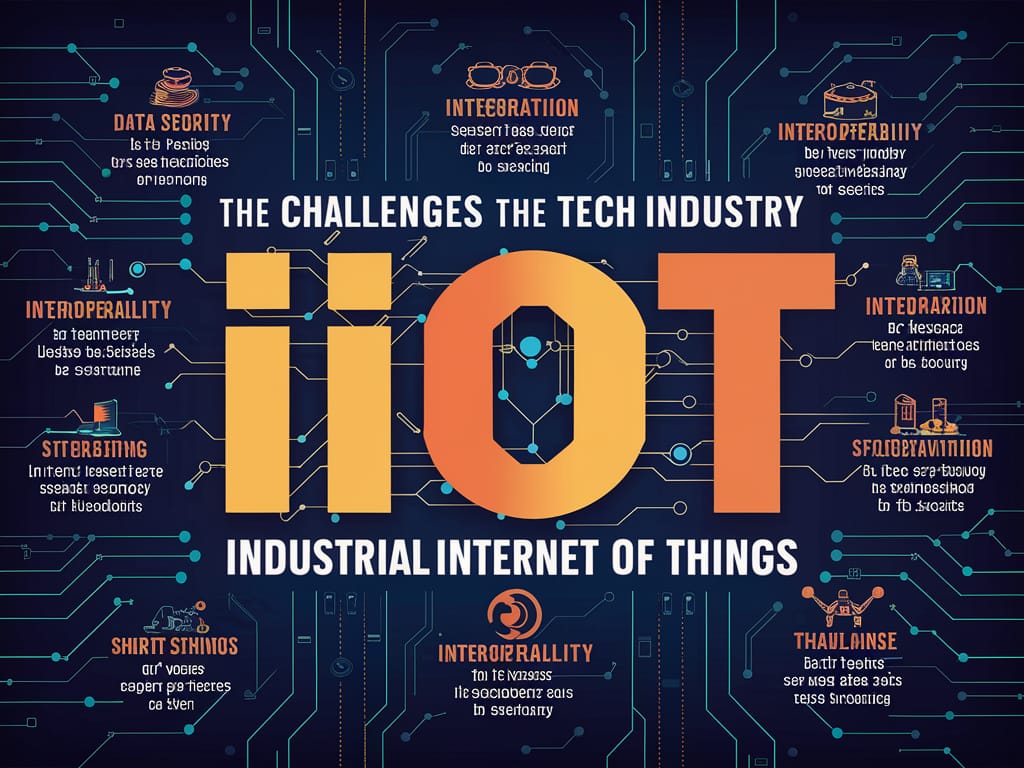
What exactly is an IIoT?
The industrial Internet of Things (IIoT), is a transformative force connecting the physical devices, machinery, and systems within industrial environments.
Why IIoT Adoption is needed?
The reasons are crucial for the adoption of the IIoT devices: –
- In today’s industry, everything works on a real-time basis, enabling real-time monitoring of the data with predictive maintenance and also process optimization.
- The data collection from the sensors and devices where the organizations can enhance efficiency to reduce downtime and improve overall productivity.
- The assets of the IIoT devices are allowed for better utilization, leading to cost savings.
- Prevention of unplanned downtime with the use of predictive maintenance thereby reducing repair costs and also improving asset lifespan.
- The quality control is facilitated by IIoT to monitor the production processes and also ensure consistent output.
- The real-time alerts to improve the safety results with an automated response in hazardous conditions.
- The supply chain visibility is also enhanced by IIoT to track the goods, inventory, and shipments.
What are the challenges of IIoT adoption?
- Concerns with security related to the connected devices increasing the attack surface.
- Data breaches, and system vulnerability leading to inadequate security measures and also unauthorized access.
- The seamless communication is hindered by diverse devices, protocols, and platforms.
- The compatibility is ensured with different vendor’s solutions.
- With the rising growth of the number of connected devices, scaling up IIoT systems also becomes complex.
- Scalability is also an issue if the data management is not efficient and the criticality of the network protocols.
- Organizational alignment is also crucial to avoid any sort of conflicting issues.
What are the strategies to overcome common IIoT adoption challenges?
- The security measures need to be implemented with regular software updates and strong authentication methods and techniques.
- Public Key Infrastructure (PKI) technologies are used for device authentication.
- The gateways must be secured to ensure safe communication within the network.
- The devices must be developed with a universal framework for open standards.
- Standard APIs must be implemented due to open-source messaging protocols.
- The stakeholders must collaborate to manage the interoperability challenges.
- The data should be efficiently managed with chosen scalable network protocols.
- A cloud-based solution for elastic scalability.
- Organizational Alignment with defining the clear-cut KPIs aligned as per the business objectives.
Well, not a single technology is without its hurdles, but the challenges need to be overcome so that appropriate benefits can be reaped at an appropriate time.
Sources:- ptc, xmpro, hologram, mckinsey, emqx, zdnet, tektelic, iotforall, smartdev
 ledlights