
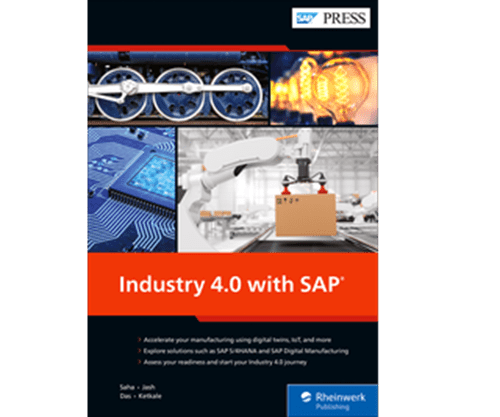
written by Dipankar Saha, Chandan Jash, Soumya Das, Anup Kumar Ketkale
https://www.sap-press.com/industry-40-with-sap_5775
15% Discount Code: IND415
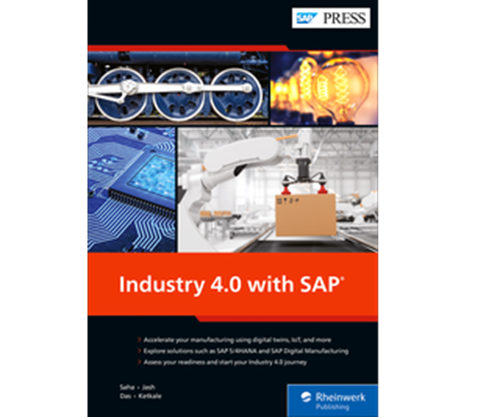
“Industry 4.0 with SAP” provides a clear understanding of the concepts and technologies of Industry 4.0 along with the relevant SAP solutions and architectures that are essential to start your Industry 4.0 journey. As Industry 4.0 is not about a single solution or technology getting a holistic understanding of the solutions and how to define the architecture across multiple solutions and platforms is the key, which is one of the key focus areas of the book.
This book can help consultants, business stakeholders, and architects as well as academic students who want to pursue this subject as a study for research, to understand the implement Industry 4.0 technologies and solutions and plan and execute the programs in a holistic approach.
This book has the first three chapters explaining the concepts and the key technologies for Industry 4.0 in detail which includes IoT, AI & machine learning.
Chapter 4 of the book focuses on Intelligent Products. The key components of intelligent product design and development are explained followed by its benefits and challenges. It explores the Intelligent product design enablers available in the market, and the readers are introduced to the SAP Intelligent Product portfolio, which is one of the popular enablers in the market. It demonstrates how it can be harnessed to create intelligent products as part of Industry 4.0 implementation.
Chapter 5 describes the key characteristics of the intelligent factory and SAP S/4HANA Manufacturing, SAP Extended Warehouse Management, and Warehouse Robotics. Next, you can find cloud-based SAP Digital Manufacturing solutions along with details functionality such as SAP Digital Manufacturing execution, SAP Digital Manufacturing Insight, shop-floor machine integration with the manufacturing process, production process designer, managing AI/ML bases scenarios, and possible enhancements and integration scenarios for SAP Digital Manufacturing.
Like the intelligent factory, the intelligent asset is another key pillar of Industry 4.0 without which Industry 4.0-based implementation for the manufacturing process cannot be completed.
In this book, you can find detailed explanations of Intelligent Asset solutions and architecture along with relevant examples in chapter 6. You can also learn about enterprise asset maintenance strategies such as breakdown maintenance, preventive maintenance, condition-based maintenance, and predictive maintenance.
Next, we have described the SAP S/4 HANA asset management process including asset master data management and asset management business functions.
Next, you can find SAP cloud-based solutions in individual sections like SAP Asset Strategy and Performance Management and SAP Predictive Asset Insights solution which are now combined in Asset Performance Management. Also, we have covered SAP Business Network for Asset Collaboration, previously.
Chapter 7 is dedicated to exploring and understanding the core of empowering people for Industry 4.0. This chapter sheds light on the essential considerations for Intelligent Personal Safety and support system requirements and provides insightful solutions to empower users as they embrace Industry 4.0.
Chapter 7 introduces the SAP Empowered People suite, which contains three distinct components. SAP Environmental Health & Safety Management (EHSM), SAP 3D Visual Enterprise, and SAP Service and Asset Manager. SAP EHSM is offered in both on-premises and cloud versions.
Industry 4.0 needs to integrate with various legacy systems, machines, and IT systems. E.g. PLC, SCADA, Historian MES as well as ERP systems such as SAP S/4HANA. One can use SAP technologies and solutions for the integration, analytics, and AI/ML scenarios.
However, some readers might be interested in learning how to realize these architectures using some of the open-source technologies such as Apache Nifi, MING stack, etc. apart from the SAP solutions.
The good news is that we have covered both in this book explaining all the architectural scenarios mentioned above to realize using both SAP solutions as well as the proven open-source technologies and platforms.
It also explains OT integration aspects and new concepts such as Unified Namespace and how to implement them, which will help you to define a modern but scalable and robust architecture. We have a whole chapter dedicated to industry scenarios and architectures in the book which is chapter 8.
As Industry 4.0 is a journey, it needs initial as well as periodic assessments on the maturity and readiness of the organization to adopt Industry 4.0. You need to follow a structured approach to determine the maturity levels across different dimensions and how ready you are as an organization for Industry 4.0 adoption.
The assessment helps you understand the gaps and where you need to improve based on which ultimately you can define the roadmap for the Industry 4.0 adoption, once you prioritize the different gaps using a prioritization methodology.
There are different maturity and readiness assessment frameworks available, two of which are the most popular and useful and used across the Industry globally. These are Smart Industry Readiness Index (SIRI) developed by the Singapore Economic Development Board with the World Economic Forum and managed by INCIT and acatech which is defined and managed by the German Academy of Science and Engineering.
We have covered these assessment frameworks in detail so that you can get an understanding of how to use these frameworks for assessment and readiness as well as prioritization planning. It also explains how to define your Industry 4.0 roadmap and plan and execute such complex programs, irrespective of which technologies, platforms, or solutions you are using.
Change management is an important aspect of any new initiative, and Industry 4.0 is a disruptive program to holistically redesign and improve the business processes and systems, it is needless to say it requires comprehensive change management planning and execution.
The change management for Industry 4.0 is not only limited to one or two dimensions but across multiple dimensions of systems, processes, technologies, people, logistics, infrastructure, etc. This needs meticulous planning and understanding of the different elements of change management and how to address them. In this book, we have given this topic great importance as we believe a complex program such as Industry 4.0 adoption cannot be just technology-driven, but rather it has to be driven from various aspects with people being one of its key elements combined with technology and process. From this book, you will learn about how to plan and execute the change management process for Industry 4.0 taking care of various elements, so that you can plan a seamless execution. As bonus tips, we have included various guidelines on how to plan and manage such programs and stakeholders which will help you to understand the various nuances and challenges of the journey and how to overcome those.
We feel this book should not considered as only relevant for SAP consultants and customers but for anyone who wants to understand Industry 4.0 in general and understand the architectures. We have also covered the common implementation scenarios using the industry use cases for both discrete and well as process industries so that it’ll help the readers to get a holistic view of the functional scenarios and processes as well as the architecture which will be helpful to implement the actual solutions across different industries.
Key Takeaways
– A single book that takes you through the entire learning journey of maturity assessment, conceptualization, design and architecture, realization, and change management covering the key technologies, use cases, and SAP solutions
– Provides deep insight into the architecture of Industry 4.0 solutions both using SAP and open-source technologies together or interchangeably
– Strategic and administrative guidance for Industry 4.0 journey with planning, change management, and key takeaways to manage such complex programs
 ledlights