
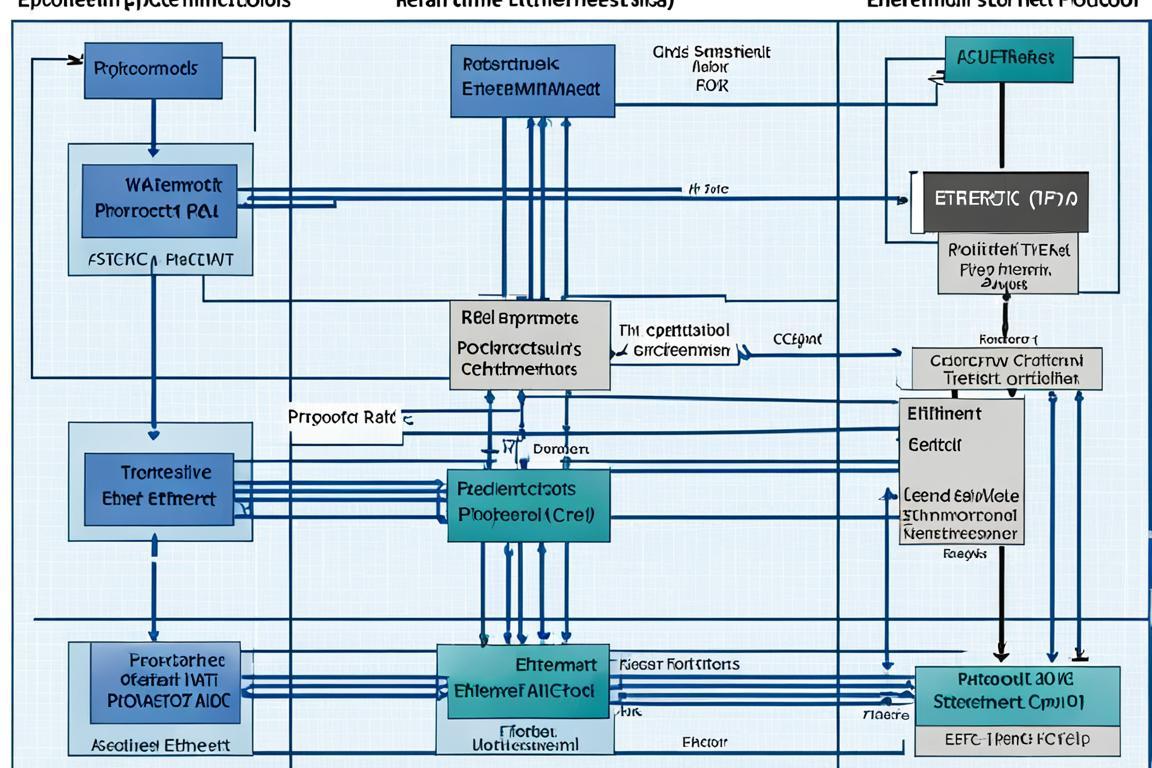
Real-time Ethernet protocols in automation technology are used for process control instead of Fieldbus systems.
Ethernet serves as an effective communication standard on layers 1 and 2 of the ISO/OSI model, facilitating the reading of sensor values and the controlling of actuators by central controllers at various points in a machine or system.
In such setups, when they take on control engineering tasks, special demands are placed on information technology.

It is crucial that latency times do not exceed the maximum limits for the specific application. Some applications, such as drive control, require the simultaneous execution of several distributed subprocesses to ensure predictable latency behavior.
As per the IEEE, deterministic transmission of data is incorporated in international ethernet standards across industries.
The developments of the Ethernet Audio Video Bridging (AVB) Task Group need Ethernet Time-Sensitive Networking for the time-critical transmission of multimedia content.
As per the broad market relevancy of the new Ethernet TSN standards, cost-effective implementations are available in the future that need to be continued for the development of the specifications.
In automation technology, the TSN technology application forms the basis for high-performance real-time Ethernet systems, such as PROFINET IRT.
OPC UA is also currently being adapted for real-time communication over Ethernet TSN.
The benefit of using PROFINET is that it supports an industrial Ethernet standard for automation technology that makes Ethernet usable for time-critical message transmission.
The purpose of Ethernet is due to its development as a unified transmission standard for office communication, with a focus on large amounts of data.
In classic information technology, latency times of a few microseconds are of secondary importance but are of high priority for automation technology.
As per Techopedia, latency means the time it takes for data to travel from one point to another within a network or system. It is a crucial factor for determining the responsiveness and performance of various applications and services.
Latency time is defined as the perceived or actual delay in response time; in industrial networks, it is the delay in time for the data packet to travel from one network node to another.
PROFINET “Real-Time” (RT) relies on the standard-compliant Ethernet MAC layer for real-time data transmission.
As per the experts, “The goal of the Ethernet TSN working group is to design a generic, largely industry-neutral basis for deterministic communication over Ethernet.”
The purpose of PROFINET RT was specifically developed for real-time relevant data over the Ethernet standards IEEE 802.1 and IEEE 802.3. The message transmission was guaranteed with soft real-time conditions, and a standardized method with PROFINET RT was used in frame prioritization.
The function of a Virtual Local Area Network (VLAN) with Priority Tagging (IEEE 802.1Q) adds an extra field to the Ethernet frame, which includes the identification number of a virtual subnet and a priority level.
Source:- Kommunikation und Bildverarbeitung in der Automation by Jürgen Jasperneite, Volker Lohweg.
 ledlights