
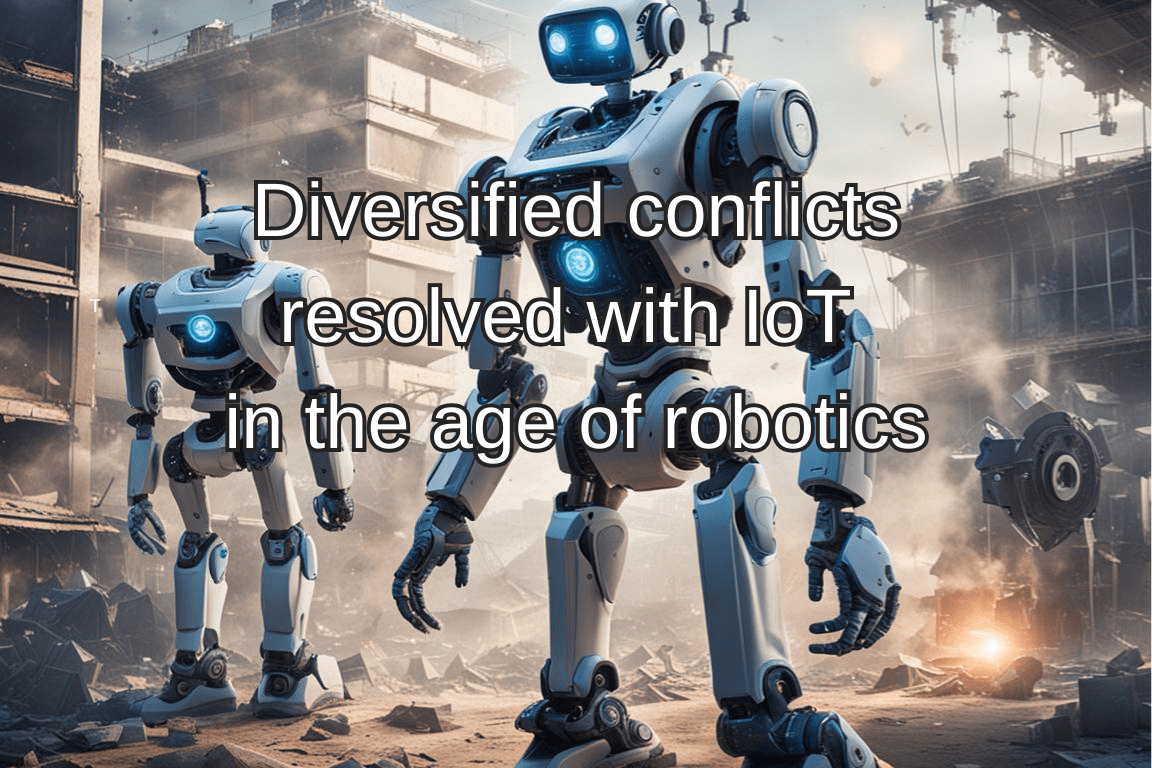
Diversified IoT in the age of robotics
Robots were not just for working professionals; they also created a massive hit and craze among kids.
Who doesn’t like Iron Man?
Transformative technologies, IoT, and robotics are reshaping sectors in various ways, be it in the vast world outside of your home, either as a toy dog to pet or as a functioning hand machine.
With the daily tech news and information, the world is completely unknown and unlimited for robotics and IoT.
However, in the practical world, there are lots of insane conflicts that are out of our hands. Can this be handled trustable by the IoT in the age of robotics?
Let’s look at the conflicts that have been resolved with the use of IoT, which has been a blessing in the modern world of robotics.
1. Conflict Resolution in Industrial Settings
Conflicts are often the theme, especially in industrial environments, due to inefficiencies, safety concerns, and resource allocation issues.
Smart factory optimization is one such example.
A factory can be optimized with the support of IoT sensors for monitoring equipment performance, energy consumption, and production rates in real time.
Once the real-time data has been received, it will be transmitted to a central AI system for controlling the actions of the robotics workers. One of the well-known situations, such as bottlenecks in production, leads to unexpected equipment failures.
The robotics workers can be dynamically assigned or reassigned to different tasks to adjust the production flow.
Well, in return, the production flow can be kept under control.
The only problem is a sudden power cut, which may not be normal and the whole system can be rebooted, but even though the failure of the Microsoft Azure cloud shows that nothing is impossible, leading to a complete standstill of the factory under the control of AI,.
According to a study by Incit,
Advanced automation and IoT implementation indicate the effective result of leading to a reduction in downtime by 30–50% and an increase in productivity by 15–30%.
2. Environmental Conflict Resolution
The goals of environmental conflicts are high, and maintaining this world of greenery is an extremely prioritized task for most civilians. IoT and robotics play crucial roles in monitoring and mitigating any sort of conflict concern in the environment.
One such example is forest fire prevention and management. In forests, IoT sensor networks can be deployed for monitoring temperature, humidity, and air quality. A high risk of fire can be indicated and can be relayed down to the robotic drones that are equipped with thermal cameras.
The drones manage to patrol the area by identifying any potential fire hotspots and taking active action by optimizing the response and minimizing damage.
In California, one of the pilot projects was conducted, and as per the reports by Environmental Science & Technology (Chang et al., 2024), the system demonstrated that the response times could be reduced by 40% and the average size of wildfires also be decreased by 35%.
3. Urban Traffic Management
One of the significant sources of conflicts are Traffic congestion in urban areas. Adaptive Traffic Management Systems with IoT sensors embedded in roads and intersections can monitor traffic flow, vehicle density, and pedestrian activity.
With Google Maps and all, you can get the right and up-to-date information about urban routes. And also the possibility of a new app with the support of IoT sensors.
The systems can communicate with each other such as autonomous vehicles with real-time routing information for traffic efficiently. According to a study “in the Journal of Intelligent Transportation Systems” (Lee et al., 2024), cities implemented technology with a 20% reduction in average commute times and a 15% decrease in traffic-related accidents.
4.Healthcare Resource Allocation
Conflicts are often due to limited resources and high demand, with IoT and robotics managing the necessary challenges.
One such example is smart hospital resource management. The location and status of medical equipment can be tracked with IoT sensors, and the patient’s vital signs can be monitored by assessing staff availability.

An AI system can be arranged as a central controller for controlling and managing the fleet of robotic assistants. At times, when the hospital is overburdened with workloads, the robot fleets could be a valuable assistant.
The resources could be allocated efficiently, with robotic assistants used as guidance for transporting the necessary equipment.
The robot system can work like an alert tool or AI assistant to alert nearby staff members and others.
A study published in the “Health Informatics Journal” (Patel et al., 2023) reported that hospitals use a system with a 40% reduction in equipment search times and a 25% improvement in emergency response times.
5. Agricultural Resource Management
In agriculture conflicts, resource allocation is important with water usage, IoT, and robotics for sophisticated solutions.
One such example is the Precision Agriculture System, with IoT sensors deployed to monitor soil moisture, nutrient levels, and crop health. The data also can be analyzed by an AI system to control a fleet of agricultural robots.
Allocation of water and nutrients is precisely done by the system by addressing the specific needs within a field.
As per the research published in “Precision Agriculture” (Garcia et al., 2024), the farms used the approach to reduce water usage by 30% while increasing crop yields by 20%.
6. Disaster Response and Management
Conflicts are rising due to limited resources, and rapid coordinated responses are also needed to enhance disaster management.
Integrate a disaster response system with IoT sensors deployed quickly in disaster-affected areas for monitoring the structural integrity of buildings, air quality, and potential hazards.
A central command system is used for coordinating the human responders and robotic units. The robots were sent to dangerous areas for survivor support, rescue team missions with delivery supplies, or clearing out debris with the IoT network providing real-time awareness.
A study report in the “Journal of Disaster Risk Reduction” (Yamomoto et al., 2023) analyzed the system to use during a major earthquake with improved resource allocation efficiency by 50%, and the survivors are also located at a reduced time of 35%.
7.Energy Grid Management
In energy distribution, the integration of renewable sources is addressed through IoT and Robotics. One such example is Smart Grid Optimization with IoT sensors powering up the grid to monitor energy production, consumption, and grid stability in real time.
As in the above cases, an AI system controls the smart inverters and robotic maintenance. The conflict provides a sudden change in renewable energy production or even unexpected demand spikes where the energy can flow dynamically or even activate energy storage systems.
According to a study in “IEEE Transactions on Smart Grid” (Smith et al., 2024), the use of grid technology improved the overall stability by 40% and the outage times also reduced by 60%.
Well, as we go down the line, IoT and robotics seem to be a powerful combination with endless opportunities and revenue schemes to resolve any sort of conflicts in various domains.
The challenge is also going to be high with security and we are not aware of how strong the threats can be and how powerfully, the system could be damaged. Ethical and privacy concerns are huge for AI and addressing the issues is going to be beneficial in the long term.
However, the domains of AI, IoT, and Robotics are going to be in the future, and the world of cybersecurity has to be strong. It needs to be powerful enough for any robot to work without being hacked or any cyber threat.
In a parallel dimension, the more strong, robust, and powerful the cyberworld is going to be, the more strong your systems and other running software can be.
 ledlights