

Artificial Intelligence- Can we call it a breakthrough innovation of our time, a major disruption to the traditional work approach, or a fall of Human labor.
Over the past ten years, AI made remarkable strides by transforming various industries and also reshaping our daily lives. The advancements in the development of sophisticated AI models or even the Teachable machine learning tool, where literally, you can train a model from home are changing the decade with rapid innovation and progress.
AI Over the Last Decade (2014-2024)
2014: Generative Adversarial Networks (GANs)
One of the most significant breakthroughs in AI came with the introduction of Generative Adversarial Networks (GANs) by Ian Goodfellow and his colleagues in 2014. GANs consist of two neural networks—a generator and a discriminator—that work together to create realistic images, videos, and other data.
The generator creates fake samples, while the discriminator evaluates them against real data. Through this adversarial process, GANs can produce remarkably realistic images and have been used in various applications, including art generation, video game design, and even creating deepfake videos.

This innovation opened new possibilities in AI-driven content creation and enhanced machine-learning techniques.
2015: Human-Level Image Recognition
In 2015, AI made substantial strides in image recognition, achieving human-level performance on the ImageNet Large Scale Visual Recognition Challenge (ILSVRC).
Deep learning models, particularly convolutional neural networks (CNNs), were instrumental in this achievement. The milestone demonstrated the power of deep learning and set the stage for further advancements in computer vision.
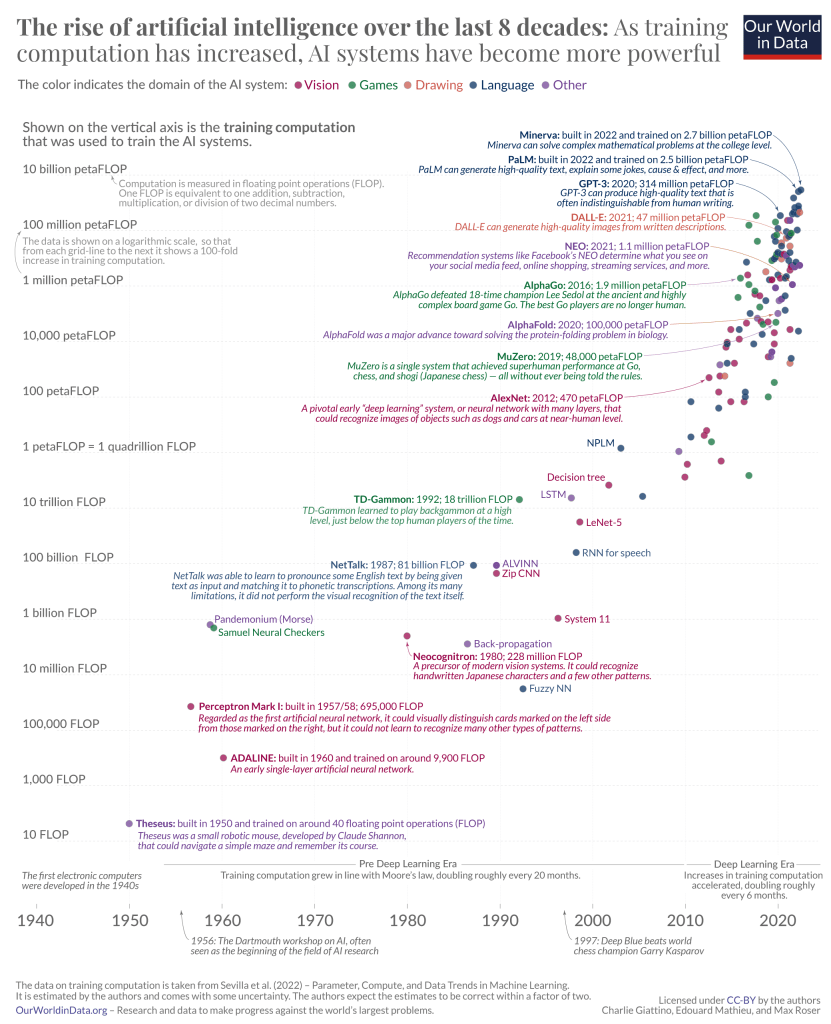
This breakthrough has had far-reaching implications, enabling technologies such as facial recognition, autonomous driving, and medical image analysis.
2016: AlphaGo Defeats World Champion
A landmark moment in AI occurred in 2016 when DeepMind’s AlphaGo defeated the world champion Go player, Lee Sedol. Go, a complex board game with more possible moves than there are atoms in the universe, had long been considered a significant challenge for AI.
AlphaGo’s victory marked a turning point, showcasing the potential of reinforcement learning and neural networks to solve complex problems. This achievement not only demonstrated the power of AI in strategic thinking but also spurred further research into AI-driven game-playing and problem-solving.
2017: AlphaGo Zero and Self-Teaching AI
Building on the success of AlphaGo, DeepMind introduced AlphaGo Zero in 2017. Unlike its predecessor, AlphaGo Zero learned to play Go from scratch, without any human input. It used reinforcement learning to train itself solely through self-play, starting with random moves and eventually achieving superhuman performance.
AlphaGo Zero’s ability to master Go independently highlighted the potential of self-teaching AI systems and opened new avenues for developing AI that can learn and adapt without human intervention.
2018: BERT and Advances in Natural Language Processing
The field of natural language processing (NLP) saw a significant breakthrough in 2018 with the introduction of BERT (Bidirectional Encoder Representations from Transformers) by Google.

BERT improved the understanding of context in language models by processing text bidirectionally, considering both the left and right context simultaneously. This advancement enabled more accurate and nuanced language understanding, leading to better performance in various NLP tasks such as question answering, sentiment analysis, and language translation. BERT’s impact has been profound, influencing subsequent NLP models and applications.
2019: GPT-2 and the Rise of Large Language Models
In 2019, OpenAI introduced GPT-2 (Generative Pre-trained Transformer 2), a large language model capable of generating coherent and contextually relevant text.
GPT-2 demonstrated the potential of transformer-based models to perform a wide range of language tasks with minimal fine-tuning. The model’s ability to generate human-like text and understand context revolutionized the field of NLP, paving the way for more advanced models like GPT-3. The release of GPT-2 also sparked discussions about the ethical implications of AI-generated content and the need for responsible AI development.
2020: GPT-3 and the Expansion of AI Capabilities
The release of GPT-3 by OpenAI in 2020 marked a significant leap forward in AI capabilities. With 175 billion parameters, GPT-3 is one of the largest language models ever created.
It can generate human-like text, perform tasks such as translation, summarization, and even coding with minimal input. GPT-3’s versatility and performance have led to widespread adoption in various applications, from chatbots and virtual assistants to content creation and software development. Its success underscored the importance of scaling up AI models to achieve better performance and versatility.
2021: AI in Healthcare and Drug Discovery
In 2021, AI continued to make significant contributions to healthcare, particularly in drug discovery and development. AI algorithms were used to analyze vast datasets, identify potential drug candidates, and predict their efficacy.
One notable example is the use of AI by companies like DeepMind and Insilico Medicine to accelerate the discovery of new treatments for diseases such as COVID-19. These advancements demonstrated the potential of AI to revolutionize drug discovery, reduce development timelines, and bring new treatments to market faster.
2022: Advancements in Autonomous Vehicles
The development of autonomous vehicles made significant strides in 2022, with companies like Tesla, Waymo, and Cruise achieving important milestones.
AI-powered systems, including advanced sensor fusion, computer vision, and machine learning algorithms, enabled autonomous vehicles to navigate complex urban environments and handle various driving scenarios.
These advancements brought us closer to the realization of fully autonomous vehicles, promising to enhance road safety, reduce traffic congestion, and revolutionize transportation.
2023: AI Ethics and Regulation
As AI technology continued to advance, ethical considerations and regulatory frameworks gained prominence in 2023. Governments, organizations, and researchers recognized the need to address issues such as bias, privacy, and accountability in AI systems.
Initiatives such as the European Union’s AI Act and the establishment of AI ethics guidelines by various institutions aimed to ensure that AI development and deployment were conducted responsibly and transparently. These efforts highlighted the importance of balancing innovation with ethical considerations to build trust in AI technologies.
2024: AI and Climate Change Mitigation
In 2024, AI played a crucial role in addressing climate change and environmental sustainability. AI algorithms were used to optimize energy consumption, improve resource management, and develop innovative solutions for reducing carbon emissions.
Projects such as Google’s AI-powered climate models and IBM’s AI-driven environmental monitoring systems demonstrated the potential of AI to contribute to global efforts in combating climate change. These initiatives underscored the importance of leveraging AI for social good and tackling some of the world’s most pressing challenges.
Sources:- rigb, Qualitance, techradar
 ledlights