
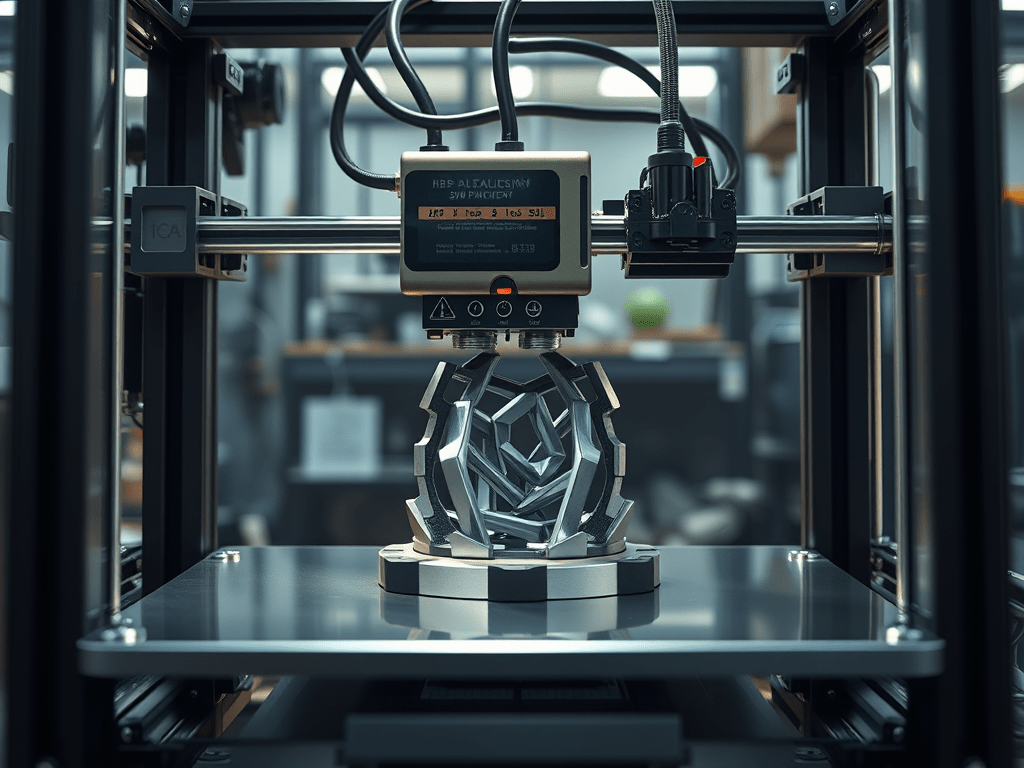
These devices—”printers” is not the right word—will radically alter the manufacturing industry and the related logistics procedures. The fact that they currently only have a little part in discourse and literature is therefore all the more shocking.
Additive manufacturing procedures are made possible by 3D printers. In contrast to more conventional subtractive techniques (such as drilling, milling, turning, etc.), additive (generative) manufacturing involves building a component by layering on a material.

The context in which 3D printing and the 3D technology industry as a whole function is extremely dynamic. It is noteworthy that national advancements in this subject are not quite as dynamic as those occurring globally. Consequently, there’s a chance of losing a competitive edge.
Generally speaking, American businesses dominate the 3D printer market. On the other side, German 3D printer producers frequently collaborate with German automakers.
3D printers are devices that create three-dimensional items gradually and methodically. Using CAD data, specialist computer programs manage the production of these items.
Devices are already priced under €1,000 for the consumer market. However, depending on the application, purchase expenses in the industrial sector can frequently exceed six-figure sums. Even at extremely dispersed sites, these machines allow for the personalized and economical production of goods (not simply in small numbers).
As previously said, 3D printers will transform the manufacturing process. Up until now, goods have been manufactured using raw resources, which frequently leads to a significant quantity of waste. 3D printers, on the other hand, use less material because they construct parts layer by layer.
The required material (such as metal, gypsum, or plastic) is used to produce the object layer by layer using a 3D model. The material is melted onto the specified place using a laser and metal powder in the case of metal or applied through nozzles in the case of plastic.
The capacity of 3D printers to produce objects with intricate shapes or complex geometries is one of their benefits. This enables the creation of parts that were previously either economically unviable due to high production costs or impractical due to technological limitations.
Rapid manufacturing, or small-series production, can also be done profitably. However, the imprecise temperature regulation of the materials utilized prevents the production of high-performance components constructed from advanced alloys at this time. It is anticipated that answers to this problem will be accessible very soon due to the quick developments in this industry.
Size and length restrictions are also imposed by modern technologies. Currently, machines are capable of producing items up to around one meter long. The quantity of parts that can be manufactured is unrestricted, though. For instance, production levels in the five-digit range have been reported by the aviation sector.
Notwithstanding these benefits, the absence of standardization—particularly with regard to 3D printing file formats—remains a significant obstacle. Ongoing initiatives in this field, however, give promise for advancements.
The 3D printing/manufacturing processes are categorized into three main methods:
Stereolithography (plastic is applied layer by layer and hardened using a laser).
Melting process (building an object layer by layer using melted materials) in the form of Fused Deposition Modeling (FDM) and PolyJet Technology.
Sintering process (material is applied in powder form and bonded using a laser).
The major advantage of the melting process of being cost-effective and produces smooth surfaces. The processing is available for a limited by the small number of materials.
The sintering process is advantageous in terms of the high mechanical strength of the printed objects and the wide variety of materials that can be used.
The stereolithographic process provides excellent surface quality with drawbacks such as high costs and a limited selection of materials to be processed. The method invented over 30 years ago, making it the most established and well-documented of the three.
Sources:- Industrie 4.0 in der Automobilproduktion by Walter Huber
 ledlights